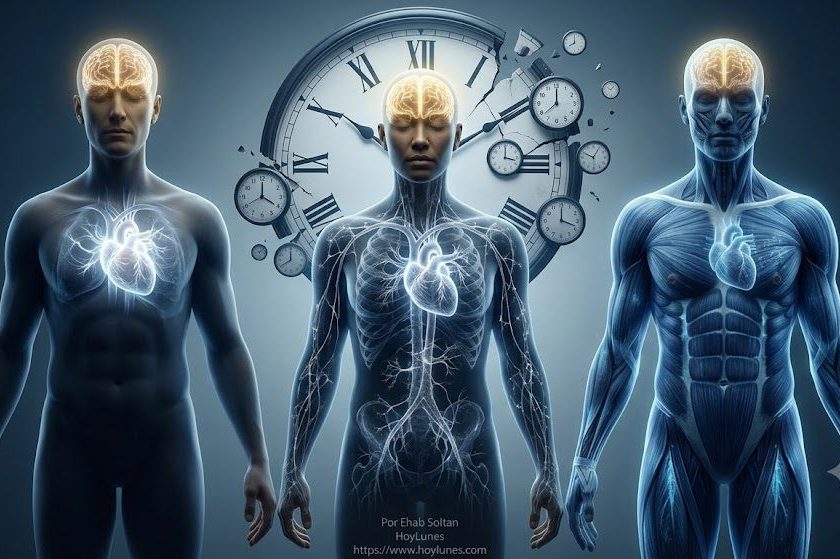

While artificial intelligence promises to extend human life, a silent fracture emerges: not everyone will access that longevity. The real disruption is not medical, it is structural.
By Ehab Soltan
HoyLunes — Historically, longevity was presented as a collective conquest. Vaccines, antibiotics, healthcare systems: advances designed to raise the life expectancy of entire populations. Progress, at least in appearance, was inclusive.
But that model is changing.
For the first time in modern history, health progress is not being distributed automatically. It is being allocated. And that difference — subtle but decisive — completely redefines the concept of health equity.
The new frontier of longevity is not being built solely in laboratories, but in systems capable of interpreting human biology in real time. And here appears a fracture that is just beginning to be discussed: the ability to live longer —and better— is ceasing to depend only on medicine, to depend on access to advanced technological infrastructure.
To understand the magnitude of this change, it is enough to observe a key indicator: while global life expectancy has increased, the gap in healthy life years between the highest and lowest economic quintiles in OECD countries still exceeds 10 years. This figure brings down a dangerous abstraction: medical progress exists, but its real benefit is conditioned by structural and, increasingly, technological factors.
The promise of living longer no longer depends solely on medical advances, but on the ability to translate data into decisions. And that ability is not distributed equitably.

From Treatment to Prediction: The Shift that Redefines Everything
Traditional medicine has operated under a reactive logic: detect, diagnose, intervene. It is a model centered on manifest pathology. However, the integration of artificial intelligence (AI) and machine learning (aprendizaje automático) is shifting this axis toward a predictive and preventive approach, often referred to as “precision medicine” or “P4” (predictive, preventive, personalized, and participatory).
In this new paradigm, the objective is no longer to treat the disease, but to anticipate it before it manifests clinically. This requires the continuous monitoring of molecular and physiological biomarkers. Recent research illustrates this shift; for example, studies on “epigenetic clocks” —like the Horvath Clock, which measures DNA methylation— show that it is possible to assess biological age more accurately than chronological age, identifying mortality risks long before symptoms of age-related diseases appear.
Advanced health platforms, such as those emerging in the deep tech ecosystem, do not limit themselves to registering medical information passively. They build dynamic systems capable of:
Analyzing omic biomarkers (genomics, transcriptomics, proteomics, metabolomics) in real time.
Detecting subtle homeostatic deviations using anomaly detection algorithms.
Generating personalized intervention protocols (nutraceutical, pharmacological, lifestyle) based on computational models of the individual.
Continuously learning and refining clinical criteria through ‘deep learning,’ replicating and surpassing human decision patterns in specific subpopulations.
The most profound change is not occurring in human biology ‘per se,’ but in the computational architecture that interprets it. And that redefines access.
However, the problem is not technical. The technology already exists. The real bottleneck is who can integrate, sustain, and turn it into actionable clinical decisions at scale.
The Silent Paradox: More Data, More Inequality
At first glance, the digitization of health and the rise of wearable devices promise a democratization of longevity. More data, more knowledge, better decisions. The reality, analyzed coldly, is more uncomfortable.
Because systems capable of transforming this massive volume of raw data into effective prevention are not available homogeneously. They require massive investment in technological capital, cloud computing infrastructure, clinical data interoperability, and, above all, a layer of sophisticated algorithmic intelligence that not all health systems or individuals are prepared to adopt.
A study published in The Lancet Digital Health underlines this point by analyzing how AI algorithms in health, if not trained with diverse and representative data sets, can perpetuate and even amplify existing biases, offering lower-quality diagnoses and recommendations to underrepresented or lower-resource groups.

Longevity is becoming a function of access: access to high-quality data, to advanced interpretation, and to early therapeutic intervention.
This introduces a structural paradox: the more AI tools advance in medicine, the greater the risk of widening the “longevity gap” between those who can anticipate and mitigate their biological deterioration through cutting-edge technology… and those who can only react to pathology once it is consolidated.
In practical terms, this means that two patients with the same cardiovascular risk may receive completely different trajectories: one with preventive intervention based on longitudinal data, and the other with late treatment after the first clinical event.
The Invisible Layer: Systems that Think for the Clinician
At the core of this transformation emerges an even more disruptive idea: systems do not only assist the professional, they begin to internalize and scale their cognitive process.
The most advanced platforms in the longevity medicine sector are already designed under this logic: clinical decision support systems (CDSS) that not only record data, but integrate complex electronic health records (EHR), learn from the patient’s phenotypic behavior, and replicate medical decision patterns with increasing precision, especially in the identification of subtle long-term risks.
Here is where artificial intelligence ceases to be a peripheral tool to become a cognitive and operational extension of the health system.
This raises a profound implication: clinical knowledge ceases to be exclusively human and begins to become a replicable infrastructure. And like all infrastructure, it can be concentrated.
But this evolution poses an uncomfortable question that sector analysts must address: if specialized clinical criteria can scale and optimize through technology… who will have access to that scale and optimization?
A Transition Already Underway
In recent conversations within the longevity ecosystem, profiles operating at the intersection of artificial intelligence and preventive health are beginning to agree on a critical point: the bottleneck is no longer basic biological scientific knowledge, but its operational and algorithmic implementation.
A new generation of technological architects is tackling precisely this challenge: translating biomedical complexity into operational decisions within real clinical settings. They are not expanding scientific knowledge itself; they are solving the sector’s most critical problem: making it usable. And it is in that layer —execution— where the real competitive advantage is being defined today.
Even without formal statements from the major players, the strategic movement of the sector is clear: it is pivoting from purely biological scientific innovation towards the technological and integrative execution of that innovation.
And that shift changes the rules of the competitive game.

The Risk No One Wants to Name
If this advanced technological infrastructure is not democratized and integrated equitably, longevity will cease to be perceived as a universal medical advance to become an economic and technological privilege.
And unlike previous inequalities, this one will not be easily visible. It will not manifest in access or non-access, but in progressive differences in health, performance, and accumulated longevity over decades.
We are not facing a traditional inequality —like access to essential medicines or standard treatments—, but a more sophisticated, silent, and hard-to-detect biological inequality: the fundamental difference between those who have the computational capacity to anticipate their molecular biological deterioration… and those who will discover it too late, when the optimal preventive intervention window has closed.
In this scenario, two individuals can live in the same geography, formally access the same health system, and yet experience radically different health and aging trajectories. Not due to genetic determinism, nor exclusively due to lifestyle, but due to the asymmetry in access to the advanced interpretation of their own biological data.
The Redefinition of Value in Health
For years, value in health has been measured in terms of short-term clinical efficacy and post-hoc therapeutic results. Today, that framework falls short in the face of the complexity of aging.
The new value emerges in the computational capacity to:
Detect biomarkers of aging before symptomatic manifestation.
Decide interventions based on personalized predictive models.
Intervene with molecular and temporal precision.
And Adapt continuously the global scientific knowledge to the unique biological profile of the individual in real time.
This is not an incremental improvement in healthcare. It is a fundamental paradigm shift. Because in this model, health ceases to be a series of specific services to become a continuous system of biological interpretation and management, a capacity that, increasingly, will depend on who controls that interpretation.
The Question that Will Define the Next Decade
The global conversation on longevity has been dominated by an optimistic and one-dimensional narrative: living longer, living better, extending human life. But this technical and media narrative often omits the most uncomfortable and critical structural variable.
The question is no longer how long we will live on average. The question is much more uncomfortable, and much more urgent for public policy strategists and technological sector leaders:
Who will have access to this computationally optimized longevity… and under what conditions of equity and data integrity?
Because if the answer depends on proprietary algorithms, cutting-edge computing infrastructure, and closed business models, then the future of health and human biology is not being decided solely in hospitals or research laboratories.
It is being decided in the architecture of the systems that interpret life. And like all critical infrastructure, those systems do not just distribute technical solutions.
They distribute biological power.
And in that scenario, longevity will cease to be a consequence of progress. It will become a structural decision.
Sources and Frameworks
Horvath S, Raj K. DNA methylation aging clocks: challenges and recommendations. Nat Rev Genet. 2018. (Technical review on epigenetic clocks).
European Commission. Ethical guidelines for trustworthy AI. (Framework on biases and equity in health algorithms).
OECD. Health at a Glance 2023: OECD Indicators. (Data on inequalities in access to health technologies).
Topol EJ. High-performance medicine: the convergence of human and artificial intelligence. Nat Med. 2019. (Technical analysis on AI as a clinical cognitive extension).
Nature Reviews Genetics
The Lancet Digital Health
World Health Organization
#LongevityTech #HealthInequality #AIinHealthcare #PrecisionMedicine #DigitalHealth #FutureOfHealth #HealthStrategy #HoyLunes #EhabSoltan